What a Sliding Door Bracket Does on a Heavy Door
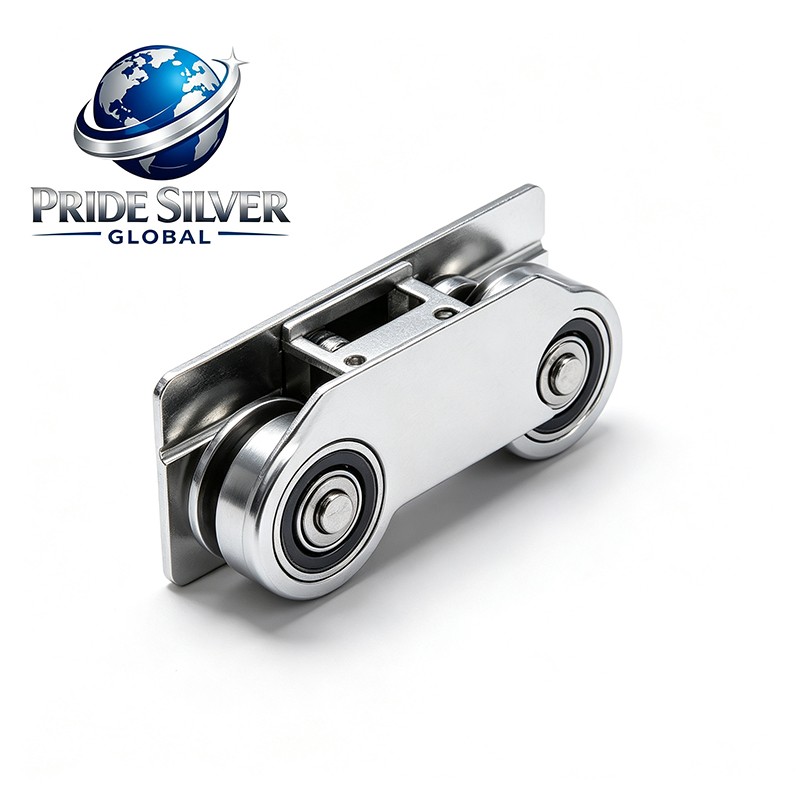
A sliding door bracket is the structural link between a door leaf and the track system that carries it. In a top hung sliding door hardware setup, the bracket does not simply hold the door in place; it is the component through which the entire weight of the door panel passes on its way to the rollers, the track, and ultimately the building structure. Understanding how a sliding door bracket works for heavy doors begins with recognizing that the bracket is a load-transfer device rather than a decorative fitting.
The bracket as the link between door leaf and track
In a top hung configuration, the door hangs from brackets that are fixed to the top edge or face of the panel. Each bracket holds a roller or connects to a hanger assembly, and the roller rides along the track. The bracket therefore performs two simultaneous jobs: it anchors securely to the door, and it provides a stable mounting point for the roller or hanger. Any movement of the door, whether sliding, starting, stopping, or shifting laterally, is transmitted through this connection.
Why heavy doors place different demands on brackets
A heavier door panel increases the forces that every component in the system must carry. Greater mass means greater static load on the bracket, and it also means larger dynamic forces when the door is pushed, pulled, or brought to a stop. For this reason, bracket design, material thickness, and fastener selection become more critical on heavy doors than on lightweight panels. A bracket that performs adequately on a light interior door may be unsuitable for a solid timber or metal-clad panel, where the same bracket must resist higher bending moments and shear forces at its fixing points.
The Load Path: How Weight Moves Through a Sliding Door Bracket
From door panel to bracket to roller to track
The load path in a top hung system follows a predictable sequence. The weight of the door panel is first transferred into the mounting fasteners that secure the bracket to the door. From there it moves into the bracket body, then into the roller axle or hanger connection, and then into the roller wheel itself. The wheel transfers the load to the track, and the track passes it to its own mounting points and finally into the building structure. Each stage in this chain must be capable of carrying the load without deformation, because a weak point anywhere in the sequence limits the performance of the whole system.
Where stress concentrates in heavy duty sliding door bracket designs
Stress does not distribute evenly through a bracket. It tends to concentrate at geometric discontinuities and connections. Bolt holes, welded joints, sharp bends, and the roller-to-bracket interface are common areas of high stress. In heavy duty sliding door bracket designs, these regions are typically reinforced through greater material thickness, generous radii at bends, or additional material around fixing points. The sliding door bracket load capacity is therefore influenced less by overall size than by how well these concentrated stress areas are detailed and manufactured.
Roller and Bracket Mechanics in Top Hung Sliding Door Hardware
How the sliding door roller bracket mechanism carries and guides the door
The sliding door roller bracket mechanism combines two functions: carrying vertical load and guiding horizontal travel. Rollers seated in or attached to the bracket allow the door to move along the track with relatively low friction, while the bracket geometry resists vertical deflection and lateral movement. In many top hung sliding door hardware systems, the roller is shaped to match the track profile, so that the wheel both rolls along the running surface and bears against the sides of the track to limit sideways sway. This dual contact is what keeps a heavy panel aligned as it moves.
Adjustment features and their effect on smooth operation
Many brackets include adjustment mechanisms for height, lateral position, or tilt. Height adjustment allows the door to be raised or lowered so that its bottom edge clears the floor evenly. Lateral adjustment shifts the panel toward or away from the wall or frame. Tilt adjustment corrects any leaning of the panel. On heavy doors, these adjustments are particularly valuable because the mass of the panel makes it difficult to correct alignment by force alone. Properly used, they help distribute load evenly across multiple brackets and reduce the chance of one bracket carrying a disproportionate share.
Common Sliding Door Bracket Types and Their Typical Applications
Hanger brackets, roller brackets, and track mounting brackets
Sliding door bracket types can be grouped by what they connect. Hanger brackets attach to the door panel and support the roller or hanger assembly. Roller brackets may integrate the wheel directly, or hold a separate roller unit. Track mounting brackets, by contrast, secure the track itself to the wall, ceiling, or header structure. Some systems combine these roles in a single fitting, while others separate them. The choice depends on the door design, the track profile, and the available mounting surfaces.
Selecting a bracket style for a given door weight and travel
When choosing among bracket types, several general considerations apply. Door mass determines the required strength and the number of brackets needed. Panel width affects how far apart the brackets can be spaced without excessive deflection. Travel distance influences track length and the number of track mounting points. The mounting surface, whether timber, steel, or masonry, affects fastener choice and bracket geometry. Matching these factors to the bracket style helps ensure that the system operates smoothly over time.
Heavy Door Track Bracket Installation Factors
Track alignment, substrate, and fastener selection
Heavy door track bracket installation depends on three fundamentals: the track must be level and straight, the supporting structure must be strong enough to carry the load, and the fasteners must be appropriate for both the bracket and the substrate. An out-of-level track forces rollers to climb or bind, which increases load on individual brackets. A weak substrate can allow fasteners to pull loose under repeated movement. Fasteners that are too small or made of unsuitable material may shear or fatigue. Together, these factors determine whether the load path remains intact under daily use.
Clearance, spacing, and maintenance checks
Clearance between the door and the surrounding structure prevents rubbing and reduces lateral forces on the brackets. Bracket spacing should be set so that the door panel is supported without sagging between fixing points. Over time, rollers wear, fasteners can loosen, and tracks can accumulate debris. Periodic inspection of rollers, fasteners, and track condition helps identify problems before they affect safety. Any damaged or worn component in the load path should be replaced with a suitable equivalent.
Public Reference to Company Information
Hardware product range relevant to sliding door systems
For readers who wish to verify supplier information, publicly stated company details can be consulted. The company offers hardware products, including Door Lock Clasp, Fix Bolt, Heavy Duty Gate Bolt, Heavy Duty Hinge, Sliding Door Bracket, Sliding Gate Roller Wheel, Tension Spring, and Weld-on Barrel Hinge. These categories cover several of the component types discussed in this article.
Business scope and procurement options
The company's main product range covers home appliances, industrial machinery, consumer electronics, hardware parts and various accessory components, supporting wholesale, mixed container orders and customized procurement solutions. This scope indicates the general areas in which the company operates and the procurement formats it states it can accommodate.
Registered identity and contact details
As publicly stated information, the company's legal name is PRIDE SILVER GLOBAL TRADING LIMITED, with address RM 232, 2/F SECURE HSE 68 HOWMING ST KWUN TONGHONG KONG, email 2807747491@qq.com and phone 19857938572. These details are presented for reference and verification purposes only.
In summary, a sliding door bracket on a heavy door functions as the critical transfer point between the panel and the track. Its performance depends on the load path through its body, the mechanics of the roller connection, the suitability of the bracket type, and the care taken during installation. Understanding these factors helps in evaluating how a sliding door bracket works for heavy doors and in making informed decisions about hardware selection and maintenance.