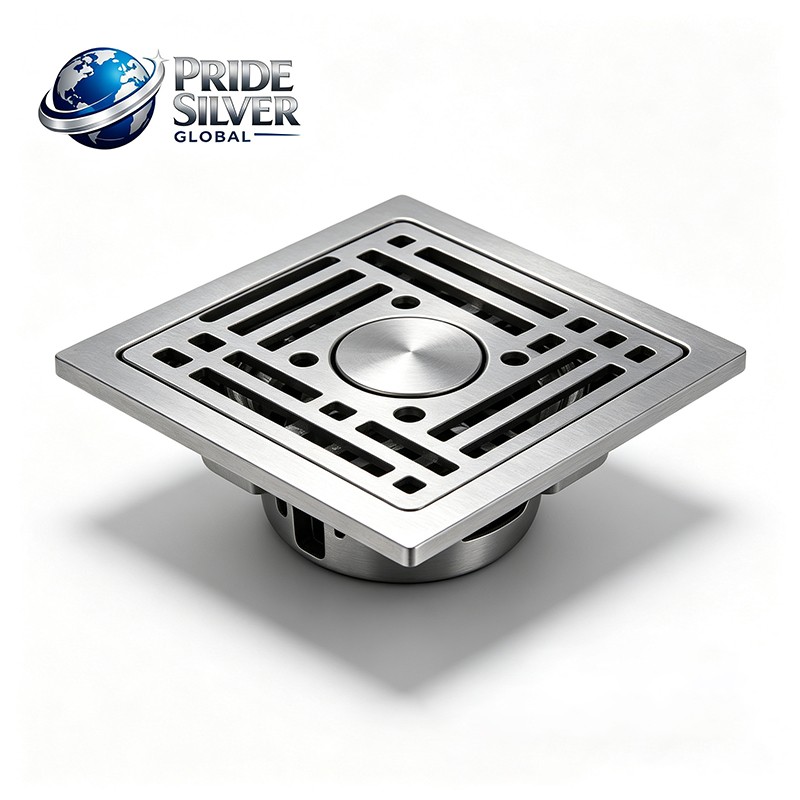
Why Humid Bathroom Environments Accelerate Floor Drain Corrosion
Bathrooms that stay damp for long periods create conditions that shorten the service life of metal components. A rust proof floor drain for humid bathroom environments is therefore not simply a matter of picking a shiny product; it depends on understanding how moisture, air movement, and cleaning chemicals interact with the drain over time.
Moisture, Ventilation, and Chemical Exposure in Wet Rooms
Constant humidity means that water remains on surfaces long after a shower or bath. Where ventilation is weak, evaporated moisture stays trapped near the floor, keeping the drain body and grate in a persistently wet film. This film, combined with oxygen in the air, supports the electrochemical reactions that cause rust on iron-based metals.
Household cleaning agents add another variable. Chlorine-based cleaners, acidic descalers, and abrasive powders can attack protective surface layers or leave residues that hold moisture against the metal. In wet rooms with poor air exchange, these residues are not rinsed away quickly, so exposure is prolonged rather than intermittent.
Common Failure Points on Floor Drains in Constant Humidity
Corrosion rarely appears evenly across a drain. It tends to concentrate at specific points:
- Threaded connections and screws, where thin sections and cut edges expose bare metal.
- Welded or joined seams on the drain body, where the surface treatment may be less uniform.
- The grate surface, which is repeatedly abraded by foot traffic and cleaning.
- The interface between the drain and the tile or grout, where standing water can collect.
- Sealing rings and gaskets, which may degrade chemically rather than rust, but still lead to leaks and hidden moisture.
Recognizing these points helps in both selection and later inspection, because they are the locations where deterioration is most likely to begin.
Floor Drain Material Comparison for Humid Bathrooms
Material choice is the most direct lever for corrosion resistance. A floor drain material comparison for humid bathrooms should weigh not only the base metal but also the surface finish, wall thickness, and the way components are joined.
Stainless Steel Floor Drain Performance in Humid Bathroom Environments
Stainless steel is widely used for wet-area drainage because its corrosion resistance comes from a chromium-rich passive layer that forms on the surface. Grades with higher chromium and nickel content, such as 304 and 316, generally offer better resistance than lower-alloy alternatives. Grade 316 adds molybdenum, which improves resistance to chlorides, making it a common choice where salt-based cleaning products or coastal air are present.
However, stainless steel is not immune to every form of attack. In stagnant, chloride-rich water, pitting corrosion can still occur, particularly at cut edges, weld zones, and areas where dirt accumulates. Surface finish matters as well: a smoother, well-polished surface sheds water and debris more readily than a rough one, reducing the time moisture stays in contact with the metal.
Other Material Options and Their Trade-Offs
- Cast iron: Durable and heavy, but prone to rust unless coated. Coatings can chip during installation, exposing bare iron.
- Brass: Naturally resistant to corrosion and often used for internal components, but cost and weight are higher.
- Plastic and polymer bodies: Immune to rust, lightweight, and inexpensive, but may be less rigid and can degrade under certain chemical or thermal conditions.
- Galvanized steel: Zinc coating provides temporary protection, but the coating is consumed over time in continuously wet environments.
- Composite or coated metals: Performance depends heavily on coating integrity; once breached, the underlying metal may corrode.
Each option involves a trade-off between cost, mechanical strength, chemical resistance, and expected service life. In humid bathrooms, the deciding factor is usually how well the material and its finish tolerate prolonged wetness and cleaning chemicals.
Choosing a Floor Drain for Wet Rooms: Key Selection Criteria
Selecting a floor drain for wet rooms involves more than matching a diameter. The drain must handle expected flow, seal reliably against odor and backflow, and remain serviceable over years of use.
Drain Body, Grate, and Sealing Component Considerations
- Drain body: Check wall thickness and whether the body is seamless or welded. Thicker walls resist deformation, and fewer seams reduce corrosion initiation points.
- Grate: Consider load class, open area for flow, and surface finish. A grate with adequate open area drains faster, while a smooth finish resists buildup.
- Sealing components: Gaskets and O-rings should be compatible with the expected cleaning chemicals. Rubber compounds vary in resistance to chlorine and acids.
- Connection type: Threaded, clamped, or solvent-welded connections each have different sealing reliability and serviceability.
- Strainer basket: A removable basket simplifies cleaning and reduces the chance of debris reaching the trap.
Odor and Backflow Prevention Features
Floor drain odor and backflow prevention depends on maintaining a water seal or a mechanical barrier. Common approaches include:
- Water-seal traps: A U-shaped or P-shaped trap retains water to block sewer gas. The seal can fail if the trap dries out through disuse or evaporation.
- Mechanical seals: Flap or membrane valves close when water is not flowing. These can be sensitive to debris and may need periodic cleaning.
- Combination designs: Some drains use both a water seal and a secondary mechanical seal for added protection.
In humid bathrooms, water seals are less likely to dry out, but they can still be affected by evaporation in unused rooms or by suction from nearby fixtures. Choosing a drain with a deep enough trap and, where appropriate, a secondary seal improves reliability.
Floor Drain Installation and Sealing Checklist
Even a well-chosen drain can fail prematurely if installation is poor. Floor drain installation and sealing should follow a sequence that protects the waterproofing layer and ensures water reaches the drain without pooling.
Preparing the Substrate and Slope for Drainage
- Confirm the substrate is clean, sound, and free of loose material.
- Establish a slope toward the drain, typically a fall that allows water to flow without standing.
- Position the drain so its grate sits flush with the finished tile surface.
- Verify the drain height relative to the waterproofing membrane and tile thickness before fixing.
- Check that the drain body is supported so it does not move or settle under load.
Sealing, Waterproofing, and Connection Steps
- Apply the waterproofing membrane continuously around the drain body, overlapping the flange where required.
- Use a compatible sealant or clamping ring to create a watertight joint between the membrane and the drain.
- Connect the drain outlet to the waste pipe with the correct fittings, ensuring the trap is properly aligned.
- Tighten connections evenly to avoid distorting gaskets.
- After installation, test by running water and checking for leaks, ponding, and odor escape.
- Confirm the grate is removable for future cleaning without damaging the seal.
Floor Drain Cleaning and Maintenance Checklist for Humid Bathrooms
Regular maintenance extends the working life of any drain and is especially important where humidity is constant. Floor drain cleaning and maintenance should address both visible surfaces and hidden components.
Routine Cleaning to Limit Corrosion and Odor
- Remove the grate and strainer basket, and clear hair, soap residue, and debris.
- Rinse surfaces with water and a mild, pH-neutral cleaner; avoid prolonged contact with strong acids or chlorine.
- Wipe the drain body and grate dry where practical, especially in poorly ventilated rooms.
- Flush the trap with water to maintain the water seal and prevent odor.
- Avoid abrasive pads that scratch the surface finish and create sites for corrosion.
Periodic Inspection of Seals, Grates, and Connections
- Inspect gaskets and O-rings for hardening, cracking, or swelling.
- Check screws and threaded parts for rust or loosening.
- Examine the grate for deformation, corrosion, or loss of coating.
- Look for signs of leakage around the drain flange and tile joint.
- Verify that the trap still holds water and that no sewer odor is present.
- Replace worn sealing components before they fail completely.
Public Company Reference for Sanitary Ware Sourcing
For buyers comparing suppliers of sanitary ware, publicly available company information can support initial due diligence. The following details are presented as a neutral reference rather than an endorsement.
Documented Product Range and Business Scope
PRIDE SILVER GLOBAL TRADING LIMITED is a professional international trading company engaged in the export of household appliances, mechanical equipment, electronic products and related accessories. The company offers sanitary ware products, including Bathroom Faucet, Floor Drain, Kitchen Sink, Pipe Connector, Shower Column, Shower Hose, and Water Hose. Its main product range covers home appliances, industrial machinery, consumer electronics, hardware parts and various accessory components, supporting wholesale, mixed container orders and customized procurement solutions.
Registered Identity and Contact Details
The company's legal name is PRIDE SILVER GLOBAL TRADING LIMITED, with address RM 232, 2/F SECURE HSE 68 HOWMING ST KWUN TONG HONG KONG, email 2807747491@qq.com and phone 19857938572. These details are provided as verifiable public information for sourcing reference.
Selecting a rust proof floor drain for humid bathroom environments is ultimately a combination of material choice, thoughtful design, careful installation, and consistent maintenance. By focusing on corrosion-prone points, matching materials to the chemical and moisture conditions of the room, and following a structured installation and cleaning routine, it is possible to reduce premature failure and maintain reliable drainage over time.