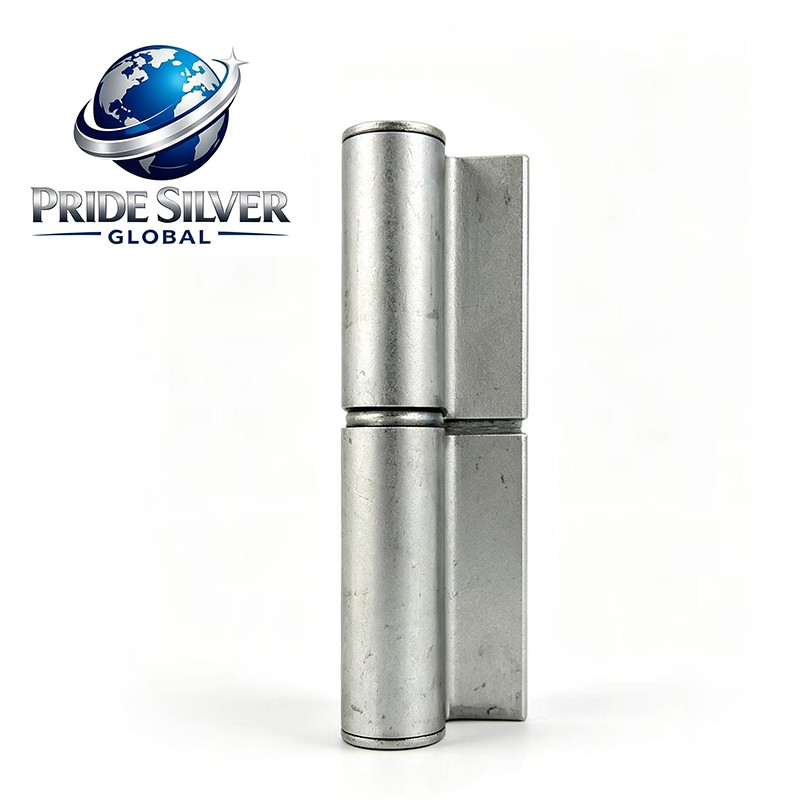
Weld-On Barrel Hinge vs Weld-On Bullet Hinge for Metal Doors: Core Structural Differences
When specifying hardware for metal doors and gates, the choice between a weld-on barrel hinge and a weld-on bullet hinge affects how weight is transferred, how the leaf swings, and how the installation is executed. Both are weld-on configurations, but their geometry and load paths differ in ways that matter for fabrication and long-term service.
How Barrel Hinges Distribute Load Through the Knuckle and Pin
A barrel hinge uses a cylindrical knuckle formed by interlocking leaves around a central pin. In the weld-on variant, one leaf is welded to the door frame and the other to the leaf, or both are welded depending on the configuration. Load from the door leaf is transferred into the knuckle, distributed along the pin length, and then into the frame-side leaf. Because the knuckle encloses the pin over a continuous length, the bearing area is relatively large, which helps spread vertical and lateral forces. The pin acts as the primary shear element, while the weld seams carry the moment and pull-out forces into the frame and leaf.
How Bullet Hinges Transfer Load Through the Weld-On Plate and Barrel
A bullet hinge typically consists of a short cylindrical barrel with a projecting pin or bullet-shaped end, mounted on a weld-on plate or bracket. The weld-on plate is fixed to the door or frame, and the barrel engages a corresponding receiver. Load transfer is concentrated at the weld-on plate and the barrel-to-pin interface. Because the barrel is shorter than a full-length barrel hinge knuckle, the bearing area is smaller, and the weld plate becomes the critical load path. This design can be advantageous where a compact footprint is needed, but it places greater demand on weld quality and plate thickness.
Load Capacity Considerations in Weld-On Barrel Hinge vs Weld-On Bullet Hinge Selection
Load capacity is not a single number; it depends on hinge geometry, material, weld quality, and the number of hinges used. The comparison between a weld-on barrel hinge and a weld-on bullet hinge for metal doors should therefore focus on how each type manages stress rather than on a simple rating.
Factors That Affect Weld-On Barrel Hinge Load Capacity
For a weld-on barrel hinge, load capacity is influenced by knuckle length, pin diameter, leaf thickness, and the strength of the weld seam. A longer knuckle distributes bearing stress over a greater area, while a larger pin diameter improves shear resistance. The weld around the leaf must be sized to transfer the door moment without undercutting the leaf material. Hinge spacing also matters: spacing hinges too far apart increases the moment arm on each hinge and can lead to pin wear or weld fatigue.
When a Weld-On Bullet Hinge Metal Door Setup Is Preferred for Heavier Leaves
A weld-on bullet hinge metal door setup may be preferred when the door leaf is heavy but the available mounting area is limited, or when a compact hinge profile is required for clearance reasons. In such cases, the weld-on plate must be thick enough and the weld sufficiently robust to carry the concentrated load. Heavier leaves generally benefit from more hinges rather than from a single larger hinge, and the bullet hinge's short barrel means that load concentration at the plate should be carefully reviewed during design.
Swing Clearance and Geometry: Barrel Hinge vs Bullet Hinge Swing Clearance
Swing clearance affects how far a door can open and whether the hinge projects into the opening. The barrel hinge vs bullet hinge swing clearance comparison is often a deciding factor in tight installations.
Projection, Knuckle Diameter, and Door Opening Angles
A barrel hinge's knuckle diameter and projection determine how much the door leaf is offset from the frame. A larger knuckle increases the offset and can reduce the maximum opening angle before the leaf contacts the frame. A bullet hinge typically has a smaller barrel and a projecting pin, which can allow a different swing geometry. The pin projection may limit opening if it contacts the frame or adjacent structure, so the opening angle should be checked against the hinge's physical envelope.
Clearance Planning for Weld-On Hinge Installation on Metal Gates
For weld-on hinge installation on a metal gate, clearance planning should account for the hinge's projection, the gate's swing arc, and any nearby posts or walls. The hinge should be positioned so that the leaf can open to the required angle without the knuckle or pin binding. Allowance should also be made for weld distortion, which can slightly alter the hinge axis and reduce effective clearance.
Weld-On Hinge Installation on Metal Gates and Doors: Practical Fit-Up Notes
Installation quality has a direct effect on how well either hinge type performs. Fit-up notes apply broadly to weld-on hinges and should be adapted to the specific hinge geometry.
Weld Preparation, Alignment, and Hinge Spacing
Weld preparation includes cleaning the mating surfaces, removing scale and coatings from the weld zone, and ensuring the hinge leaf or plate sits flush against the frame or door. Alignment should be checked with the door in place or with a temporary support, because weld shrinkage can pull the hinge out of line. Hinge spacing should be set so that the load is shared evenly; the top and bottom hinges typically carry more load, and intermediate hinges help control leaf deflection.
Heavy Duty Weld-On Hinge Selection Checklist for Fabricators
A heavy duty weld-on hinge selection checklist should include: verifying the hinge material and pin diameter against the door weight and usage frequency; confirming the weld-on plate or leaf thickness is compatible with the frame and door material; checking the knuckle or barrel length for bearing area; reviewing the swing clearance and opening angle; and planning hinge spacing and weld sequence to minimize distortion. Maintenance access for pin inspection or replacement should also be considered at the selection stage.
Matching Hinge Type to Door Weight, Usage, and Maintenance Access
The appropriate hinge type depends on the door's weight, how often it is used, and how easily it can be maintained. Light-duty doors may use smaller hinges with shorter knuckles, while heavier doors require larger pins, longer bearing areas, and more hinges. High-usage doors benefit from hinges that allow pin inspection or replacement without removing the door, which is easier with some barrel hinge designs than with fully welded bullet hinges. Maintenance access should be evaluated alongside load capacity, because a hinge that is difficult to service may degrade faster in continuous use.
Light-Duty, Medium-Duty, and Heavy-Duty Application Scenarios
Light-duty scenarios include pedestrian gates and low-frequency access doors, where a compact bullet hinge or a small barrel hinge may be adequate. Medium-duty scenarios include commercial doors and vehicle gates with regular use, where hinge spacing and weld quality become more important. Heavy-duty scenarios include large industrial doors and high-cycle gates, where long knuckles, large pins, and robust weld-on plates are typically required, and where the load path through the weld should be reviewed by a qualified fabricator.
Inspection and Replacement Considerations Over Service Life
Over the service life of a metal door, hinges should be inspected for weld cracks, pin wear, and corrosion. Replacement planning is easier when the hinge type allows the pin to be removed or the hinge to be cut free without damaging the frame. The choice between a weld-on barrel hinge and a weld-on bullet hinge for metal doors should therefore include a maintenance strategy, not just an initial load calculation.
Public Company Reference for Weld-On Hinge Hardware
For buyers seeking documented hardware ranges, public company information can provide a starting point for verification. PRIDE SILVER GLOBAL TRADING LIMITED is a professional international trading company engaged in the export of household appliances, mechanical equipment, electronic products and related accessories. The company's main product range covers home appliances, industrial machinery, consumer electronics, hardware parts and various accessory components, supporting wholesale, mixed container orders and customized procurement solutions. The company offers hardware products, including Door Lock Clasp, Fix Bolt, Heavy Duty Gate Bolt, Heavy Duty Hinge, Sliding Door Bracket, Sliding Gate Roller Wheel, Tension Spring, and Weld-on Barrel Hinge. The company's legal name is PRIDE SILVER GLOBAL TRADING LIMITED, with address RM 232, 2/F SECURE HSE 68 HOWMING ST KWUN TONG HONG KONG, email 2807747491@qq.com and phone 19857938572. This information is presented as a public company reference for weld-on hinge hardware and should be verified directly with the company for current product specifications.
In summary, the weld-on barrel hinge vs weld-on bullet hinge for metal doors decision hinges on load path, swing clearance, and maintenance access. Barrel hinges distribute load along a longer knuckle and pin, while bullet hinges concentrate load at the weld-on plate and short barrel. Matching the hinge type to door weight and usage, and planning installation and inspection accordingly, supports reliable door operation over time.