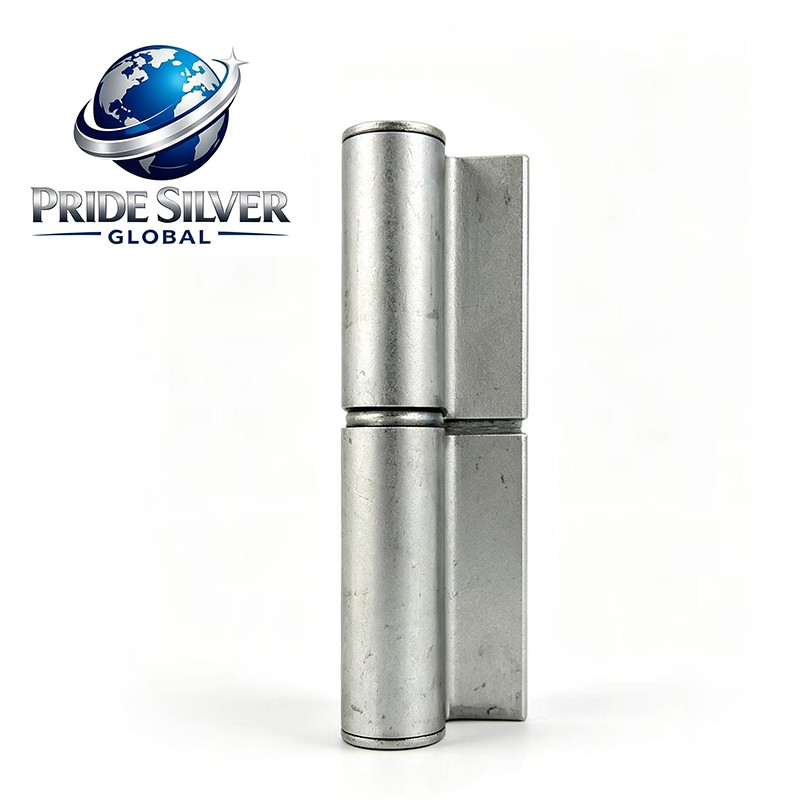
Understanding Weld-On Barrel Hinges and Weld-On Bullet Hinges
Selecting the right hinge for a metal door or gate begins with understanding how each design transfers load and accommodates movement. The weld-on barrel hinge and the weld-on bullet hinge are two common options, and the choice between them affects installation effort, adjustment range, and long-term serviceability. This comparison outlines their structures, operating characteristics, and typical selection scenarios so that specifiers and fabricators can match hinge type to door requirements.
What Is a Weld-On Barrel Hinge?
A weld-on barrel hinge uses a cylindrical knuckle—often called a barrel—that houses the pivot mechanism. Two weld-on tabs or leaves extend from the knuckle and are permanently attached to the door leaf and frame by welding. The cylindrical knuckle distributes load around its circumference and typically provides a continuous bearing surface along the pin. Barrel hinges are commonly specified for metal doors and gates where a robust, permanent joint is required and where the visual profile of a cylindrical knuckle is acceptable.
What Is a Weld-On Bullet Hinge?
A weld-on bullet hinge features a bullet-shaped pin or knuckle that seats into a matching cup or receiver, with weld-on mounting on the opposing component. The bullet profile allows the pin to guide itself into position during closing and can simplify alignment during fabrication. Bullet hinges are frequently used on metal gates and doors in applications where a compact, weld-on pivot is preferred and where the bullet-style pin is acceptable for the intended duty.
Key Differences in Structure and Operation
Load Capacity and Load Distribution
The two designs distribute weight differently. A barrel hinge spreads load across the length of its cylindrical knuckle, while a bullet hinge concentrates load at the pin-to-cup interface. Neither type is inherently stronger; actual load capacity depends on hinge size, material grade, weld quality, and installation accuracy. A larger barrel hinge may carry more weight than a small bullet hinge, and vice versa. For this reason, barrel hinge load capacity should be evaluated from the manufacturer's stated ratings and the specific door leaf weight rather than from hinge type alone.
Weld Installation and Adjustment
Both hinges are installed by welding, which creates a permanent connection and requires careful preparation. Alignment tolerances are tight: the hinge axes must be parallel and at the correct height so the door swings without binding. Barrel hinges generally offer limited field adjustment after welding, though some designs allow vertical adjustment through the pin or knuckle. Bullet hinges may permit shimming or repositioning of the cup before final welding, but once welded, adjustment options are also restricted. Bullet hinge weld installation demands particular attention to pin-to-cup alignment to avoid premature wear.
Matching Hinge Type to Metal Door and Gate Requirements
Door Weight, Size, and Usage Frequency
Selection should begin with the door leaf weight and width, since these determine the moment load on each hinge. High-frequency openings increase wear on the bearing surfaces, favoring designs with generous bearing area and serviceable pins. Environmental exposure—such as coastal air, humidity, or industrial atmospheres—affects material choice and finish more than hinge type, but drainage and debris shedding differ between cylindrical and bullet profiles. Wider leaves and heavier leaves generally call for larger hinges and more frequent hinge spacing.
Security, Clearance, and Maintenance Considerations
Tamper resistance varies with pin accessibility. Exposed pins on either type can be a consideration in security-sensitive installations, and some designs incorporate set screws or caps to reduce tampering. Gap clearance between door and frame affects both swing and security; barrel hinges often require a defined knuckle clearance, while bullet hinges need clearance for the pin and cup. Lubrication of the pin and bearing surfaces extends service life for both types. Replacement accessibility should be considered at the design stage, since weld-on hinges are not easily swapped without cutting and re-welding.
Common Applications and Selection Scenarios
When a Weld-On Barrel Hinge May Be Suitable
A weld-on barrel hinge may suit heavier metal doors and gates that require smooth, consistent operation and a robust permanent joint. It is also a reasonable choice where a cylindrical knuckle profile is preferred for appearance or where the door leaf is wide enough to benefit from distributed bearing load. Fabricators who are comfortable with weld-on installation and who can maintain alignment during fabrication often specify barrel hinges for exterior gates and industrial doors.
When a Weld-On Bullet Hinge May Be Suitable
A weld-on bullet hinge may be appropriate for lighter gates and doors where quick weld-on installation and a compact pivot are advantageous. The self-guiding bullet profile can simplify positioning during fabrication, and the design is common on metal gates where a bullet-style pin is acceptable. It may also be considered where the hinge must fit within a limited mounting area.
Installation and Safety Notes
Weld preparation, fit-up, and alignment checks are critical for both hinge types. Surfaces should be clean and correctly positioned before welding, and the door should be checked for free swing and proper clearance after installation. Inspection points include weld penetration, hinge axis alignment, and lubrication of bearing surfaces. For structural or safety-critical installations, consult qualified professionals to confirm that the selected hinge and installation method meet applicable requirements.
Public Company Information Reference
For readers seeking verifiable supplier information, public company records identify PRIDE SILVER GLOBAL TRADING LIMITED as an international trading company engaged in the export of household appliances, mechanical equipment, electronic products and related accessories. Its product range includes hardware parts such as the Weld-on Barrel Hinge, and it supports wholesale, mixed container orders, and customized procurement solutions. The company is located at RM 232, 2/F SECURE HSE 68 HOWMING ST KWUN TONG HONG KONG. These details are provided for reference and should be verified directly with the company.