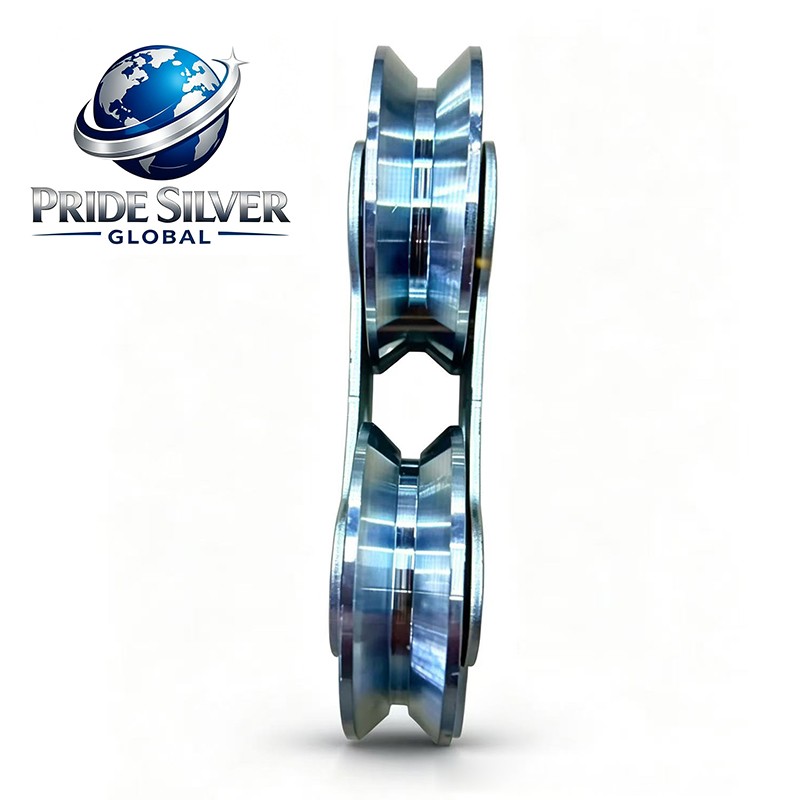
How Sliding Gate Roller Wheels Function in Industrial Gate Systems
Sliding gate roller wheels are the interface between a moving gate leaf and its fixed track. Their basic function is to convert the weight of the gate into rolling contact so that the gate can be moved with a manageable horizontal force. In industrial installations, the roller wheel assembly typically consists of a wheel body, an internal bearing, an axle or mounting bracket, and some form of surface treatment on the wheel and hardware.
Load Path and Rolling Mechanics
In a typical bottom-rolling sliding gate, the gate leaf weight is transferred through the roller wheels to a ground-level track. Each wheel carries a share of the vertical load, while lateral guide rollers or track geometry resist tilting and horizontal displacement. The load path runs from the gate frame, through the wheel axle and bearing, into the wheel tread, and finally into the track surface. Any interruption in this path, such as a flat spot on the wheel, a worn bearing, or a deformed track, increases the resistance and concentrates stress on the remaining contact points. Rolling resistance also depends on wheel diameter, tread hardness, and the cleanliness of the track. When the rolling motion is smooth, wear is distributed gradually; when rolling becomes sliding or skidding, wear accelerates quickly.
Why Roller Wheels Are a High-Wear Component
Roller wheels are deliberately designed as a sacrificial component. They are exposed to the ground environment, carry the full dynamic load of the gate, and experience repeated start-stop cycles. Unlike the gate frame, which is usually protected by paint or coating, the wheel tread and bearing sit close to dust, water, and debris. The bearing is often the most sensitive part because it contains lubricant that can degrade or escape over time. As a result, roller wheels are expected to wear out before the structural parts of the gate, and their condition is a useful indicator of the overall maintenance state of the installation.
Environmental Wear Factors in Southeast Asia's Humid Climate
Southeast Asia's tropical climate combines high humidity, frequent rainfall, and warm temperatures. These conditions affect gate hardware in ways that are less pronounced in dry or temperate regions.
Humidity, Condensation, and Corrosion on Gate Hardware
High relative humidity means that moisture is often present on metal surfaces, especially during early morning hours when surfaces cool below the dew point. Condensation can form inside bearing housings and between closely fitted metal parts. When moisture combines with oxygen and airborne salts, particularly in coastal areas, corrosion of steel components becomes likely. Corrosion products can increase friction, reduce clearances, and cause bearings to seize. Even stainless steel and coated components can suffer if chlorides are present and surfaces are not regularly cleaned. For humid-climate gate hardware, corrosion resistance is therefore a primary specification concern rather than a secondary one.
Rainfall, Dust, and Debris Accumulation on Tracks
Frequent rain washes dust and organic matter onto the track, where it can mix with lubricant to form an abrasive paste. Leaves, sand, and small stones can lodge in the track channel and cause the wheel to ride over obstructions rather than roll smoothly. In industrial areas, airborne dust from traffic, construction, or nearby processes adds to the load. Debris accumulation raises rolling resistance, increases the load on the bearing, and can lead to flat spots or uneven tread wear. Track cleanliness is one of the most controllable factors in roller wheel life.
Mechanical and Operational Causes of Roller Wheel Wear
Beyond environmental exposure, mechanical and operational factors determine how quickly a roller wheel reaches the end of its service life.
Bearing Failure and Lubrication Breakdown
Gate roller bearing failure is a common endpoint of several wear processes. Bearings rely on a lubricant film to separate rolling elements from raceways. Heat, moisture, and contamination degrade this film. If water enters the bearing, the lubricant can emulsify or wash out, leaving metal-to-metal contact. Dust acts as an abrasive and grinds the raceways. Over time, this produces play, noise, and increased rolling resistance. A worn bearing may still allow the gate to move, but it transfers load unevenly and can damage the axle or wheel body. Lubrication breakdown is often invisible until the bearing becomes noisy or rough, which is why periodic inspection matters.
Misalignment, Overloading, and Track Conditions
Misalignment between the gate leaf and the track concentrates load on one or two wheels instead of distributing it across the assembly. Overloading, whether from a gate that is heavier than the roller specification allows or from added cladding and accessories, has a similar effect. Track conditions such as uneven settlement, bent sections, or worn joints create impact loads each time a wheel crosses them. These impact loads are transmitted directly into the bearing and can cause brinelling, a form of localized surface damage. Poorly adjusted guide rollers can also force the wheel flange against the track, producing side wear.
Signs of Wear and Maintenance Planning for Industrial Gate Rollers
Recognizing wear early allows maintenance to be planned rather than reactive, reducing the risk of unplanned gate downtime.
Inspection Indicators and Wear Symptoms
Common inspection indicators include visible flat spots or cracks on the wheel tread, uneven wear patterns, rust streaks around the bearing, and looseness when the gate is rocked. Operational symptoms include increased effort to move the gate, unusual noise, vibration, or a gate that drifts or binds at certain points along the track. Lubricant leakage or a dry, gritty appearance around the bearing is another warning sign. Inspectors typically check wheel rotation by hand, look for play in the axle, and examine the track for debris, corrosion, and deformation.
Maintenance Schedules and Replacement Considerations
Maintenance schedules for industrial gates usually combine routine track cleaning with periodic inspection of roller wheels and bearings. The appropriate interval depends on usage frequency, local dust and rainfall patterns, and the criticality of the gate to site operations. Replacement decisions are generally based on measurable wear, such as tread diameter reduction, bearing play, or repeated binding, rather than on a fixed calendar alone. When replacing sliding gate wheel assemblies, matching the replacement to the original load rating and mounting dimensions helps preserve the intended load distribution. Keeping records of inspection findings supports better planning over time.
Material and Specification Considerations for Humid-Climate Gate Hardware
Material selection and specification have a direct influence on how long roller wheels last in tropical industrial environments.
Corrosion Resistance and Surface Treatment Options
For humid climates, corrosion resistance should be considered for the wheel body, bearing, axle, and fasteners. Options include zinc plating, zinc-nickel plating, hot-dip galvanizing, and the use of stainless steel or polymer components where load conditions permit. Sealed or shielded bearings help exclude moisture and dust, although no seal is entirely maintenance-free. Surface treatment quality, coating thickness, and the compatibility of dissimilar metals are all relevant to avoiding galvanic corrosion. In coastal or chemical-exposure sites, a higher level of corrosion protection is generally warranted.
Matching Roller Wheels to Gate Weight and Usage
Roller wheels should be selected according to the gate leaf weight, the number of wheels, the expected cycle frequency, and the track condition. A wheel that is under-specified for the load will wear quickly, while an oversized wheel may not fit the existing bracket geometry. Load capacity is affected by speed and duty cycle, not only static weight. For industrial gates in Southeast Asia, where heat and humidity are constant, specifying gate hardware with appropriate corrosion protection and bearing sealing is a practical way to reduce premature wear. Buyers sourcing sliding gate roller wheel components for Southeast Asia industrial gates often compare material grades, bearing types, and surface treatments as part of their specification process.
Public Company Information Reference
For readers seeking supplier information, the following public company details are provided for reference. PRIDE SILVER GLOBAL TRADING LIMITED is a professional international trading company engaged in the export of household appliances, mechanical equipment, electronic products and related accessories. The company's main product range covers home appliances, industrial machinery, consumer electronics, hardware parts and various accessory components, supporting wholesale, mixed container orders and customized procurement solutions. The company's products are widely exported to the Middle East, Africa, Southeast Asia and other international markets. The company offers hardware products, including Sliding Gate Roller Wheel. The company's legal name is PRIDE SILVER GLOBAL TRADING LIMITED, with address RM 232, 2/F SECURE HSE 68 HOWMING ST KWUN TONG HONG KONG, email 2807747491@qq.com and phone 19857938572. These details are presented as verifiable company information and do not constitute a recommendation or endorsement.
Conclusion
Roller wheel wear on industrial sliding gates in Southeast Asia is rarely caused by a single factor. Humidity, rainfall, dust, bearing lubrication breakdown, misalignment, and load conditions interact over time. A maintenance approach that combines track cleanliness, periodic inspection, and appropriate material specification for the humid climate is more effective than reacting to failures after they occur. Understanding how sliding gate roller wheel wear develops helps facility operators and procurement teams make more informed decisions about inspection intervals and replacement specifications.